At the same time, investor demand is increasingly concentrated on the €250,000 commercial-to-residential conversion route.
Migration Ministry figures show that 3,086 Golden Visa applications were submitted during the first seven months of 2026, compared with 5,028 during the same period in 2025 — a 39% decline. Monthly application volumes have remained relatively consistent this year, ranging from 392 to 497 and averaging about 440. At that rate, total filings for 2026 are expected to exceed 5,000.
The decline follows a broader reduction in application numbers. Greece recorded 7,021 applications for the full year 2025, 25% fewer than the record 9,372 applications filed in 2024.
Meanwhile, authorities are now deciding more applications each month than they receive. The number of outstanding files, which included more than 52,000 investors and family members at the beginning of 2025, had fallen to 29,273 by the end of July 2026.
The composition of new demand is changing as well. Most current applications are reportedly being filed through the €250,000 route for commercial properties converted into residential units, rather than through the standard property investment categories. Greek lawyer Alexander Varnavas had anticipated this shift when the revised investment thresholds were announced in March 2024.
Greece's Golden Visa Backlog Is Shrinking
For years, administrative capacity was one of the program's main weaknesses. Applications accumulated faster than immigration authorities could process them, with waiting periods extending beyond 18 months.
That pattern changed in spring 2025. Since then, the number of decisions issued each month has remained above the number of new applications received.
Two developments have helped drive the change. First, processing was decentralized, distributing applications between regional offices instead of concentrating the workload in a single overburdened Athens office. Second, Law 5275/2026, which has been in force since February, introduced automatic allocation of new applications to the office with the shortest queue.
The decline in incoming applications has reinforced the effect. With 39% fewer applications being submitted in the first seven months of 2026, fewer files are entering the system while existing cases continue to be processed.
Processing Times Are Improving
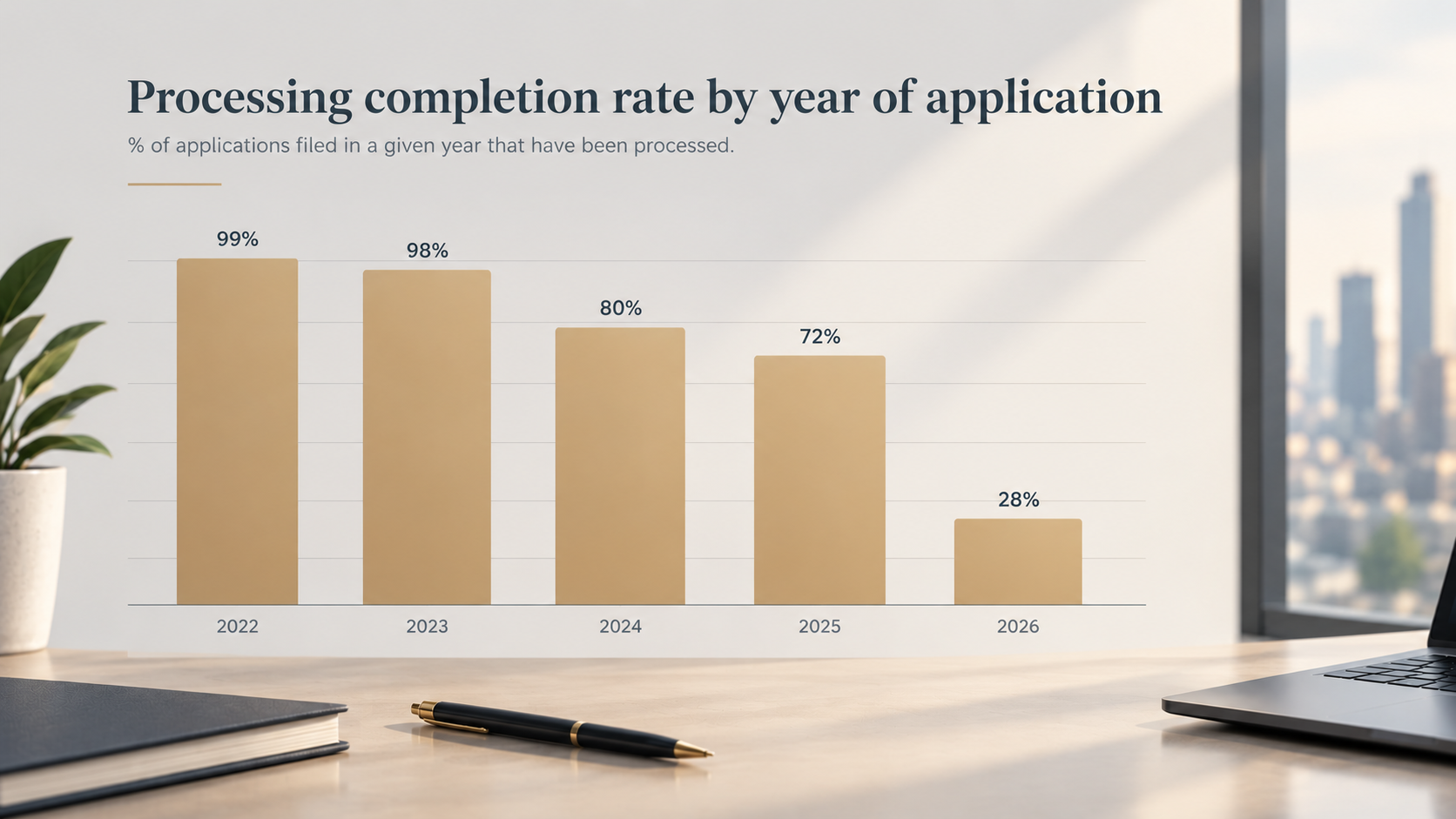
The improvement is visible across different application cohorts. Almost all applications submitted in 2023 have now been completed, while most cases from 2024 have also been decided.
More recent applications are moving through the system considerably faster than before. Well-prepared files can now, in some cases, be completed within months rather than the years that applicants previously faced.
The monthly figures reinforce the same trend: decisions have consistently outnumbered new applications.
Law 5275/2026 also addressed another consequence of lengthy processing times. The five-year residence permit period now begins when the residence card is issued rather than when the application was filed. As a result, administrative delays no longer reduce the period of residence for which the investor has qualified.
The Drop in Applications Does Not Necessarily Signal Lower Demand
The 39% decline should not automatically be interpreted as a corresponding fall in international interest in Greece.
Alexander Risvas, managing partner of Athens-based Risvas & Associates, describes the change as a restructuring of demand following the increase in investment thresholds. In his assessment, the higher thresholds — rather than a comparable loss of interest in Greece — account for much of the reduction.
The previous application volumes were heavily concentrated in the residential market around the former €250,000 threshold, particularly in Athens and Piraeus. Raising the standard investment requirement in Attica to €800,000 removed a substantial portion of the potential investor pool from that segment.
Risvas considers restrictions on short-term rentals relevant primarily to investors focused on rental yields, but regards them as less significant than the increase in the minimum investment threshold.
Christina Georgaki of Georgaki Law Firm takes a similar view of the current figures but emphasizes the unusually high number of applications filed before the new thresholds took effect. The announcement of the higher requirements triggered a surge as investors sought to secure the lower investment levels.
According to Georgaki, the 2026 figures therefore represent a return to more normal market conditions after the rush caused by the legislative change.
€250,000 Conversion Route Gains Ground
The growing share of applications using the €250,000 commercial-to-residential conversion route is consistent with what lawyers are seeing in the market.
Risvas describes the category as the most accessible real-estate option for investors seeking residence in Athens and other high-demand areas without committing €800,000.
Unlike the €400,000 and €800,000 investment categories, the conversion route is not subject to the 120-square-meter minimum property size requirement. That difference has influenced the type of properties now available to investors.
The market has increasingly developed around smaller apartments, many of which are created by converting former offices, commercial premises and similar buildings into residential units. Such properties can work well for investors whose primary objective is obtaining a residence permit, but may be less suitable for families looking for a larger residence.
Investors generally do not purchase a commercial property and undertake the conversion themselves. Instead, developers acquire the buildings, carry out the conversion and market the completed or soon-to-be-completed residential units from €250,000. The purchase price already reflects the acquisition, construction and conversion costs.
Additional expenses are primarily transaction and application costs, including transfer tax, notarial and land-registry fees, legal fees and government charges for the residence permit. As Georgaki explains, tax and fees associated with the Golden Visa are paid separately from the property purchase price.
Current Application Figures May Understate Demand
There is also a timing issue that makes the decline in applications less straightforward to interpret.
Greek law requires the change of use to be completed before a Golden Visa application can be submitted. Many conversion projects currently being offered to investors, however, have not yet reached completion.
An investor may already have chosen a property, signed a reservation agreement or progressed significantly with the purchase process without appearing in the Migration Ministry's application statistics.
Risvas therefore points to a lag between underlying investment demand and the formal submission of Golden Visa applications. Investors involved in unfinished conversion projects may have to wait until the relevant works are completed before their applications can enter the official statistics.
In his view, the market is undergoing a substantial restructuring rather than experiencing a straightforward collapse in demand. The more significant question may now be whether developers can deliver enough completed properties that satisfy legal requirements and remain commercially attractive within the investment categories investors are prepared to use.
Active Golden Visa Permits Continue to Increase
As authorities process more applications than they receive, the number of active investor permits continues to grow.
By the end of July 2026, Greece had 34,278 active investor permits, including both initial and renewed permits for principal applicants. That compares with 22,001 in June 2025.
Chinese nationals continue to represent by far the largest group of Golden Visa holders, accounting for slightly more than half of all active investor permits.
Proposed Property Portfolio Route Could Broaden Investment Options
A potential new Golden Visa structure could further change the market.
Greece's National Housing Policy Strategy 2026–2035 was approved by the government and published in the Government Gazette on August 17. It includes a proposal for a new Golden Visa category under which investors could distribute the qualifying investment across several properties instead of committing the full amount to a single asset.
The proposed properties would have to be placed exclusively on the long-term rental market.
The measure is not yet an available Golden Visa route. It remains a proposal and requires separate implementing legislation. Key details, including the minimum investment, the number of properties an investor could acquire and the applicable lease requirements, have yet to be determined.
Risvas therefore cautions that investors should not yet treat the portfolio structure as an existing option.
If the final terms are sufficiently attractive, however, both lawyers expect considerable interest. Risvas argues that allocating €800,000 across several smaller apartments could make greater economic sense for many investors than concentrating the same amount in a single property.
Georgaki likewise expects a multi-property structure to appeal to investors seeking higher yields, greater diversification and a wider choice of properties.
Such a model would also support the government's objective of increasing the supply of long-term rental housing — the same policy objective underlying Greece's restrictions on short-term rentals.
If you're planning to obtain a residence permit, invest in a country's economy, or purchase foreign real estate, we invite you to a consultation with our company. During a personal online meeting, we'll discuss your questions in detail and create a step-by-step action plan for you.