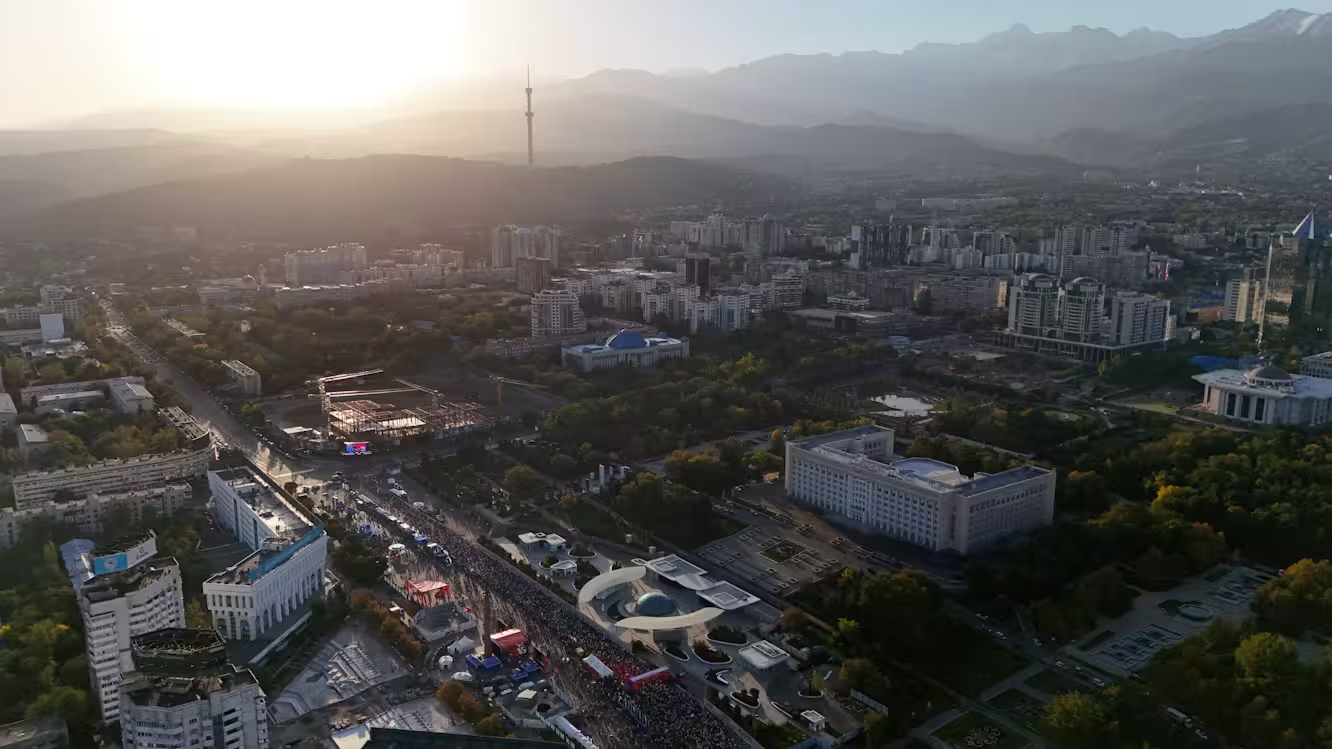
That began to change in 2025, when Kazakhstan and Uzbekistan introduced dedicated investor residence programs within weeks of one another.
Today, two of the region’s five republics offer purpose-built residence permits for foreign investors. Neither provides a citizenship-by-investment option. Kyrgyzstan and Turkmenistan also have investor residence mechanisms that were established earlier, while Tajikistan has no comparable investment-based route.
Across the region, investment thresholds generally range from about US$60,000 to US$500,000. Naturalization can take anywhere from less than three years to seven, while the treatment of existing citizenship differs significantly between jurisdictions.
For prospective applicants, the key question is therefore not simply what each program costs, but what type of residence, tax position, business access, or eventual citizenship it can realistically provide.
Kazakhstan
Kazakhstan currently has the region’s most developed investor offering. Its Golden Visa entered into force on May 10, 2025, providing a renewable residence permit valid for ten years — one of the longer validity periods available under investor residence programs internationally.
Applicants must contribute at least US$300,000 to the charter capital of a Kazakh company or invest in securities listed locally. Property purchases are excluded from the qualifying investment, directing the program toward business and capital-market investment rather than real estate.
The application process is fully electronic, and the residence permit can cover the investor’s spouse and dependent children.
There is also a lower-cost option through the Astana International Financial Centre (AIFC), Kazakhstan’s common-law financial jurisdiction. Under its Investment Tax Residency Programme, applicants must hold approximately US$60,000 in securities listed on the Astana exchange. The resulting visa is valid for five years, while tax residency may be established after just 90 days of physical presence.
For entrepreneurs, the tax regime is arguably the most attractive feature. AIFC residents can keep income earned outside the zone outside the Kazakh tax net. This gives Astana a position somewhat comparable to Dubai as a potential low-tax base for entrepreneurs seeking to establish themselves in the region rather than obtain another passport.
Kazakhstan has also developed immigration options for remote professionals. The one-year Neo Nomad Visa, introduced in November 2024, allows foreign nationals to reside in the country while working for overseas employers. A separate longer-term residence pathway is aimed at technology specialists. Neither program is investment-based, although both are included in IMI’s Complete Digital Nomad Visa Guide.
Astana gained another international draw in August 2026 with the reopening of the Network School. The co-living and co-working community, founded by former Coinbase chief technology officer Balaji Srinivasan, moved to Kazakhstan after Malaysian authorities revoked its operator’s business license in Johor in July.
Kazakhstan subsequently entered into a five-year cooperation agreement with the project covering AI education, research, and technology entrepreneurship. The school states that its Astana campus was developed in partnership with the government.
Srinivasan has indicated that residents of the campus would benefit from expedited visa processing and simpler company redomiciliation. These statements should, however, be treated as intentions rather than as a separate immigration route. The cooperation agreement establishes a framework, while any accelerated processing remains subject to Kazakhstan’s existing immigration and corporate rules.
The route to citizenship is considerably longer. An investor can seek permanent residence after approximately two years under the Golden Visa, after which the five-year naturalization period begins. Applicants are also subject to a requirement to spend at least 183 days in the country each year.
Naturalization requires knowledge of the Kazakh language, history, and constitution, as well as evidence of financial self-sufficiency and a successful background check. Kazakhstan does not permit dual citizenship, meaning applicants who naturalize must give up their existing nationality. In practical terms, the complete process is therefore closer to seven years than the five-year naturalization period might initially suggest.
Kazakhstan’s passport does have one structural advantage despite its relatively limited international travel access. As a member of the Eurasian Economic Union (EAEU), Kazakhstan gives its citizens the right to live and work throughout the bloc, which also comprises Armenia, Belarus, Kyrgyzstan, and Russia.
Uzbekistan
Uzbekistan introduced a donation-based Golden Visa on June 1, 2025, following a presidential decree signed in April of that year. The program forms part of a wider Investor Visa framework containing several different residence options.
Under the donation route, an applicant receives a five-year residence permit in exchange for a one-time US$250,000 contribution to a state account. The required contribution rises by US$150,000 for each family member, and the route is available regardless of nationality.
Applicants can also pursue an investment-based residence permit. An investment of approximately US$250,000 in a locally registered company can qualify for a renewable three-year permit. Alternatively, an investment of US$3 million in enterprises producing goods or services can result in a ten-year permit. Dependents are included without an additional charge under these investment routes.
Real estate provides another route to permanent residence. The required investment depends on location, starting at US$100,000 in the regions and reaching US$300,000 in Tashkent. Unlike the donation option, however, this pathway is restricted to nationals of specified countries.
The donation route carries an important practical caveat. At the time the presidential decree was adopted, the implementing resolution had not yet been issued. By mid-2025, it still appeared to be pending, meaning banks were unable to process the required payments. Applicants should therefore verify the current operational status of the route before relying on it.
An investor visa does not itself provide a direct route to citizenship. Foreign nationals must first hold permanent residence for at least five years, demonstrate proficiency in Uzbek, and renounce their other nationalities before applying for naturalization.
Uzbekistan previously considered a much more direct approach. In 2022, the government proposed legislation that would have introduced a US$1 million citizenship-by-investment option. The proposal never became law, and the country ultimately proceeded with residency-based investment routes instead.
Kyrgyzstan, Turkmenistan and Tajikistan
Kyrgyzstan and Turkmenistan do not market their investor residence schemes as Golden Visas, but both have investment-based routes that were established before Kazakhstan and Uzbekistan introduced their programs in 2025.
Kyrgyzstan offers the region’s lowest investment threshold and, on paper, its quickest investor pathway to citizenship. Applicants must invest KGS 10 million — approximately US$114,000 — in a qualifying sector within the previous three years. Eligible areas include industry, manufacturing, agriculture, banking, energy, education, medicine, construction, and information and communication technology.
Successful applicants receive permanent residence rather than a temporary investor permit. After approximately two years of actively operating the business, they can apply for citizenship, with the application process itself taking an additional roughly six months.
The framework is based on Resolution No. 632 of 2019 and is administered through the State Investment Promotion and Protection Agency.
Because the investment requirement is denominated in Kyrgyz som, its equivalent in US dollars will fluctuate with exchange rates.
Turkmenistan has a separate investor residence regime established under Law No. 96-VI of 2023. Applicants must invest US$500,000 in a new or existing business. The law also provides for eligibility based on exceptional achievements in science, culture, art, or sport.
Permanent residence can follow two years of continuous residence, while citizenship is available after seven years. Applicants must demonstrate knowledge of Turkmen, income derived from lawful activity within the country, and commitment to the constitution through the required oath.
Tajikistan is the only one of the five Central Asian republics without an investor-specific residence route. Foreign nationals seeking to remain in the country must therefore rely on conventional residence permits.
The Citizenship Reality
There is currently no citizenship-by-investment program anywhere in Central Asia. None of the five republics offers investors a direct passport-for-investment arrangement. Instead, citizenship, where available, comes through naturalization following the required period of residence.
The timelines differ considerably. Kyrgyzstan can provide an investor route to citizenship in less than three years. Uzbekistan requires at least five years of permanent residence, while Turkmenistan requires seven years. Kazakhstan also comes out at roughly seven years once the period needed to obtain permanent residence is included.
There is one notable route that does not require residence, although it is unrelated to investment. Under the Quadrilateral Agreement between Kyrgyzstan, Kazakhstan, Belarus, and Russia, people born in the former Soviet Union before 1991 may qualify for naturalization in a member state without first establishing residence there.
Demand for this provision surged in recent years. According to IMI, more than 7,000 Russians obtained Kyrgyz citizenship in 2024, representing a 1,650% increase compared with 2021. The increase followed the closure of Caribbean citizenship-by-investment programs to Russian applicants. Processing times subsequently expanded from four months to nine, and Kyrgyzstan suspended applications from Russian nationals in February 2025.
The treatment of dual citizenship is another major consideration.
Kazakhstan and Uzbekistan require applicants to renounce their previous nationality when naturalizing. Turkmenistan does not recognize dual nationality, while Tajikistan generally prohibits it, subject to an exception created by its bilateral treaty with Russia recognizing Tajik-Russian dual citizenship.
Kyrgyzstan takes a different approach. It is the only country among the five to recognize dual citizenship in principle. The policy does not extend to citizens of neighboring China, Kazakhstan, Tajikistan, and Uzbekistan, and dual nationals are prohibited from holding positions including the presidency, parliamentary seats, judicial office, and senior government posts.
Passport mobility presents another limitation. Kazakh and Uzbek passports provide visa-free access to a relatively modest number of destinations, well below the travel access associated with many Caribbean or European citizenship programs. For applicants primarily seeking international mobility, the eventual passport therefore offers limited value.
The stronger benefit is regional rather than global. Kazakhstan and Kyrgyzstan are members of the Eurasian Economic Union, allowing their citizens to live and work across Armenia, Belarus, Kazakhstan, Kyrgyzstan, and Russia. In that context, the passport can provide meaningful regional settlement rights even if its broader visa-free travel benefits remain limited.
Detailed naturalization requirements for the five republics, as well as almost 200 other countries, are covered in the IMI Citizenship Catalog.
Who Is Central Asia For?
For most investors, the principal attraction of Central Asia is not a second passport. The more relevant benefits are a regional foothold, business access, or a potentially favorable tax base.
Entrepreneurs primarily motivated by taxation may find the AIFC route in Kazakhstan particularly interesting. With an investment of around US$60,000, a potential path to tax residency after 90 days, and no local taxation on income earned outside the zone, Astana can serve as a credible low-tax base for someone developing a business in the region.
For investors specifically seeking a Central Asian passport, Kyrgyzstan stands apart. It has the lowest investment threshold, the shortest naturalization timeline, and — subject to the applicable restrictions — allows dual citizenship. The trade-off is that the applicant is expected to genuinely operate the business associated with the investment.
Those looking for a larger long-term presence may instead consider Kazakhstan's US$300,000 Golden Visa or Uzbekistan's US$3 million enterprise route. Both can provide residence for up to ten years, although the eventual path to citizenship remains lengthy for applicants intending to settle permanently.
For families seeking residence without establishing or operating a business, Uzbekistan's donation and real estate pathways may offer the simpler options, provided the operational status of the donation route has first been confirmed.
Central Asia is a poor fit for applicants whose primary objective is international mobility. None of these programs provides access to the Schengen Area, the passports are comparatively limited, and naturalization generally takes years. Those seeking visa-free travel are likely to find greater value in Caribbean citizenship or a European Golden Visa.
How to Assess These Programs
Central Asia has entered the investment migration market primarily as a residence destination, and its programs should be evaluated on that basis.
Entry costs can be relatively low, Kazakhstan's tax framework can be particularly attractive for certain entrepreneurs, and the newer programs may continue to evolve as the authorities refine their implementation.
These schemes make the most sense when viewed as tools for establishing a life or business presence in the region rather than as shortcuts to a powerful second passport. Applicants who approach them primarily for global travel mobility are likely to be disappointed.
The underlying product is residence — and, in some cases, access to a regional business and tax environment — rather than citizenship.
If you're planning to obtain a residence permit, invest in a country's economy, or purchase foreign real estate, we invite you to a consultation with our company. During a personal online meeting, we'll discuss your questions in detail and create a step-by-step action plan for you.
Today, two of the region’s five republics offer purpose-built residence permits for foreign investors. Neither provides a citizenship-by-investment option. Kyrgyzstan and Turkmenistan also have investor residence mechanisms that were established earlier, while Tajikistan has no comparable investment-based route.
Across the region, investment thresholds generally range from about US$60,000 to US$500,000. Naturalization can take anywhere from less than three years to seven, while the treatment of existing citizenship differs significantly between jurisdictions.
For prospective applicants, the key question is therefore not simply what each program costs, but what type of residence, tax position, business access, or eventual citizenship it can realistically provide.
Kazakhstan
Kazakhstan currently has the region’s most developed investor offering. Its Golden Visa entered into force on May 10, 2025, providing a renewable residence permit valid for ten years — one of the longer validity periods available under investor residence programs internationally.
Applicants must contribute at least US$300,000 to the charter capital of a Kazakh company or invest in securities listed locally. Property purchases are excluded from the qualifying investment, directing the program toward business and capital-market investment rather than real estate.
The application process is fully electronic, and the residence permit can cover the investor’s spouse and dependent children.
There is also a lower-cost option through the Astana International Financial Centre (AIFC), Kazakhstan’s common-law financial jurisdiction. Under its Investment Tax Residency Programme, applicants must hold approximately US$60,000 in securities listed on the Astana exchange. The resulting visa is valid for five years, while tax residency may be established after just 90 days of physical presence.
For entrepreneurs, the tax regime is arguably the most attractive feature. AIFC residents can keep income earned outside the zone outside the Kazakh tax net. This gives Astana a position somewhat comparable to Dubai as a potential low-tax base for entrepreneurs seeking to establish themselves in the region rather than obtain another passport.
Kazakhstan has also developed immigration options for remote professionals. The one-year Neo Nomad Visa, introduced in November 2024, allows foreign nationals to reside in the country while working for overseas employers. A separate longer-term residence pathway is aimed at technology specialists. Neither program is investment-based, although both are included in IMI’s Complete Digital Nomad Visa Guide.
Astana gained another international draw in August 2026 with the reopening of the Network School. The co-living and co-working community, founded by former Coinbase chief technology officer Balaji Srinivasan, moved to Kazakhstan after Malaysian authorities revoked its operator’s business license in Johor in July.
Kazakhstan subsequently entered into a five-year cooperation agreement with the project covering AI education, research, and technology entrepreneurship. The school states that its Astana campus was developed in partnership with the government.
Srinivasan has indicated that residents of the campus would benefit from expedited visa processing and simpler company redomiciliation. These statements should, however, be treated as intentions rather than as a separate immigration route. The cooperation agreement establishes a framework, while any accelerated processing remains subject to Kazakhstan’s existing immigration and corporate rules.
The route to citizenship is considerably longer. An investor can seek permanent residence after approximately two years under the Golden Visa, after which the five-year naturalization period begins. Applicants are also subject to a requirement to spend at least 183 days in the country each year.
Naturalization requires knowledge of the Kazakh language, history, and constitution, as well as evidence of financial self-sufficiency and a successful background check. Kazakhstan does not permit dual citizenship, meaning applicants who naturalize must give up their existing nationality. In practical terms, the complete process is therefore closer to seven years than the five-year naturalization period might initially suggest.
Kazakhstan’s passport does have one structural advantage despite its relatively limited international travel access. As a member of the Eurasian Economic Union (EAEU), Kazakhstan gives its citizens the right to live and work throughout the bloc, which also comprises Armenia, Belarus, Kyrgyzstan, and Russia.
Uzbekistan
Uzbekistan introduced a donation-based Golden Visa on June 1, 2025, following a presidential decree signed in April of that year. The program forms part of a wider Investor Visa framework containing several different residence options.
Under the donation route, an applicant receives a five-year residence permit in exchange for a one-time US$250,000 contribution to a state account. The required contribution rises by US$150,000 for each family member, and the route is available regardless of nationality.
Applicants can also pursue an investment-based residence permit. An investment of approximately US$250,000 in a locally registered company can qualify for a renewable three-year permit. Alternatively, an investment of US$3 million in enterprises producing goods or services can result in a ten-year permit. Dependents are included without an additional charge under these investment routes.
Real estate provides another route to permanent residence. The required investment depends on location, starting at US$100,000 in the regions and reaching US$300,000 in Tashkent. Unlike the donation option, however, this pathway is restricted to nationals of specified countries.
The donation route carries an important practical caveat. At the time the presidential decree was adopted, the implementing resolution had not yet been issued. By mid-2025, it still appeared to be pending, meaning banks were unable to process the required payments. Applicants should therefore verify the current operational status of the route before relying on it.
An investor visa does not itself provide a direct route to citizenship. Foreign nationals must first hold permanent residence for at least five years, demonstrate proficiency in Uzbek, and renounce their other nationalities before applying for naturalization.
Uzbekistan previously considered a much more direct approach. In 2022, the government proposed legislation that would have introduced a US$1 million citizenship-by-investment option. The proposal never became law, and the country ultimately proceeded with residency-based investment routes instead.
Kyrgyzstan, Turkmenistan and Tajikistan
Kyrgyzstan and Turkmenistan do not market their investor residence schemes as Golden Visas, but both have investment-based routes that were established before Kazakhstan and Uzbekistan introduced their programs in 2025.
Kyrgyzstan offers the region’s lowest investment threshold and, on paper, its quickest investor pathway to citizenship. Applicants must invest KGS 10 million — approximately US$114,000 — in a qualifying sector within the previous three years. Eligible areas include industry, manufacturing, agriculture, banking, energy, education, medicine, construction, and information and communication technology.
Successful applicants receive permanent residence rather than a temporary investor permit. After approximately two years of actively operating the business, they can apply for citizenship, with the application process itself taking an additional roughly six months.
The framework is based on Resolution No. 632 of 2019 and is administered through the State Investment Promotion and Protection Agency.
Because the investment requirement is denominated in Kyrgyz som, its equivalent in US dollars will fluctuate with exchange rates.
Turkmenistan has a separate investor residence regime established under Law No. 96-VI of 2023. Applicants must invest US$500,000 in a new or existing business. The law also provides for eligibility based on exceptional achievements in science, culture, art, or sport.
Permanent residence can follow two years of continuous residence, while citizenship is available after seven years. Applicants must demonstrate knowledge of Turkmen, income derived from lawful activity within the country, and commitment to the constitution through the required oath.
Tajikistan is the only one of the five Central Asian republics without an investor-specific residence route. Foreign nationals seeking to remain in the country must therefore rely on conventional residence permits.
The Citizenship Reality
There is currently no citizenship-by-investment program anywhere in Central Asia. None of the five republics offers investors a direct passport-for-investment arrangement. Instead, citizenship, where available, comes through naturalization following the required period of residence.
The timelines differ considerably. Kyrgyzstan can provide an investor route to citizenship in less than three years. Uzbekistan requires at least five years of permanent residence, while Turkmenistan requires seven years. Kazakhstan also comes out at roughly seven years once the period needed to obtain permanent residence is included.
There is one notable route that does not require residence, although it is unrelated to investment. Under the Quadrilateral Agreement between Kyrgyzstan, Kazakhstan, Belarus, and Russia, people born in the former Soviet Union before 1991 may qualify for naturalization in a member state without first establishing residence there.
Demand for this provision surged in recent years. According to IMI, more than 7,000 Russians obtained Kyrgyz citizenship in 2024, representing a 1,650% increase compared with 2021. The increase followed the closure of Caribbean citizenship-by-investment programs to Russian applicants. Processing times subsequently expanded from four months to nine, and Kyrgyzstan suspended applications from Russian nationals in February 2025.
The treatment of dual citizenship is another major consideration.
Kazakhstan and Uzbekistan require applicants to renounce their previous nationality when naturalizing. Turkmenistan does not recognize dual nationality, while Tajikistan generally prohibits it, subject to an exception created by its bilateral treaty with Russia recognizing Tajik-Russian dual citizenship.
Kyrgyzstan takes a different approach. It is the only country among the five to recognize dual citizenship in principle. The policy does not extend to citizens of neighboring China, Kazakhstan, Tajikistan, and Uzbekistan, and dual nationals are prohibited from holding positions including the presidency, parliamentary seats, judicial office, and senior government posts.
Passport mobility presents another limitation. Kazakh and Uzbek passports provide visa-free access to a relatively modest number of destinations, well below the travel access associated with many Caribbean or European citizenship programs. For applicants primarily seeking international mobility, the eventual passport therefore offers limited value.
The stronger benefit is regional rather than global. Kazakhstan and Kyrgyzstan are members of the Eurasian Economic Union, allowing their citizens to live and work across Armenia, Belarus, Kazakhstan, Kyrgyzstan, and Russia. In that context, the passport can provide meaningful regional settlement rights even if its broader visa-free travel benefits remain limited.
Detailed naturalization requirements for the five republics, as well as almost 200 other countries, are covered in the IMI Citizenship Catalog.
Who Is Central Asia For?
For most investors, the principal attraction of Central Asia is not a second passport. The more relevant benefits are a regional foothold, business access, or a potentially favorable tax base.
Entrepreneurs primarily motivated by taxation may find the AIFC route in Kazakhstan particularly interesting. With an investment of around US$60,000, a potential path to tax residency after 90 days, and no local taxation on income earned outside the zone, Astana can serve as a credible low-tax base for someone developing a business in the region.
For investors specifically seeking a Central Asian passport, Kyrgyzstan stands apart. It has the lowest investment threshold, the shortest naturalization timeline, and — subject to the applicable restrictions — allows dual citizenship. The trade-off is that the applicant is expected to genuinely operate the business associated with the investment.
Those looking for a larger long-term presence may instead consider Kazakhstan's US$300,000 Golden Visa or Uzbekistan's US$3 million enterprise route. Both can provide residence for up to ten years, although the eventual path to citizenship remains lengthy for applicants intending to settle permanently.
For families seeking residence without establishing or operating a business, Uzbekistan's donation and real estate pathways may offer the simpler options, provided the operational status of the donation route has first been confirmed.
Central Asia is a poor fit for applicants whose primary objective is international mobility. None of these programs provides access to the Schengen Area, the passports are comparatively limited, and naturalization generally takes years. Those seeking visa-free travel are likely to find greater value in Caribbean citizenship or a European Golden Visa.
How to Assess These Programs
Central Asia has entered the investment migration market primarily as a residence destination, and its programs should be evaluated on that basis.
Entry costs can be relatively low, Kazakhstan's tax framework can be particularly attractive for certain entrepreneurs, and the newer programs may continue to evolve as the authorities refine their implementation.
These schemes make the most sense when viewed as tools for establishing a life or business presence in the region rather than as shortcuts to a powerful second passport. Applicants who approach them primarily for global travel mobility are likely to be disappointed.
The underlying product is residence — and, in some cases, access to a regional business and tax environment — rather than citizenship.
If you're planning to obtain a residence permit, invest in a country's economy, or purchase foreign real estate, we invite you to a consultation with our company. During a personal online meeting, we'll discuss your questions in detail and create a step-by-step action plan for you.